
The GENIUS Act sets rules for the companies that create stablecoins. It does not set rules for the businesses that accept them. Here is what the GENIUS Act USDT rules mean for you in practice: it is completely legal for a US business to take USDT as payment for goods it sold. It always was, and this law does not change that. If you are an importer or exporter taking USDT from buyers, you do not become a regulated entity in 2027. What changes is which stablecoins are legal to offer in the United States, and how hard your bank will look at the ones you hold.
In this article
What the GENIUS Act USDT rules actually do
Signed into law in July 2025, the GENIUS Act creates the first federal framework for payment stablecoins in the United States. The GENIUS Act USDT framework creates an official category of approved company allowed to create payment stablecoins, sets standards for what those companies must hold in reserve and what they must disclose, and puts federal regulators including the OCC and the FDIC in charge of watching them.
The short version: a dollar-pegged stablecoin sold in the US will need to come from an approved company, backed one to one by safe, cash-like reserves it can actually sell, and subject to regular reporting. That is a meaningful upgrade from the previous situation, where reserve quality was a matter of trust and voluntary attestation.
The timeline that matters
Three dates decide when this becomes real. Federal regulators were required to issue implementing regulations within one year of enactment, which put the deadline in July 2026. The OCC published its proposed rules in March 2026 and a separate anti-money-laundering and sanctions proposal shortly after, with the FDIC following in April 2026.
The statute itself takes effect on the earlier of two triggers: 18 months from enactment, which is 18 January 2027, or 120 days after the primary regulators issue final rules. In practice, plan for the framework to be live in early 2027.
There is a longer runway for distribution. Exchanges and wallet apps have until July 2028 before they are barred from offering non-approved stablecoins to anyone in the US. That gap between 2027 and 2028 is the window in which the market sorts itself into compliant and non-compliant tokens.
Does the GENIUS Act apply to my business?
If you sell goods and accept USDT as payment, you are not creating a stablecoin and you are not running an exchange. The Act does not impose issuer obligations on you. This is the single most misread part of the coverage, and it is worth being precise about, because the compliance burden being described in most articles is not yours.
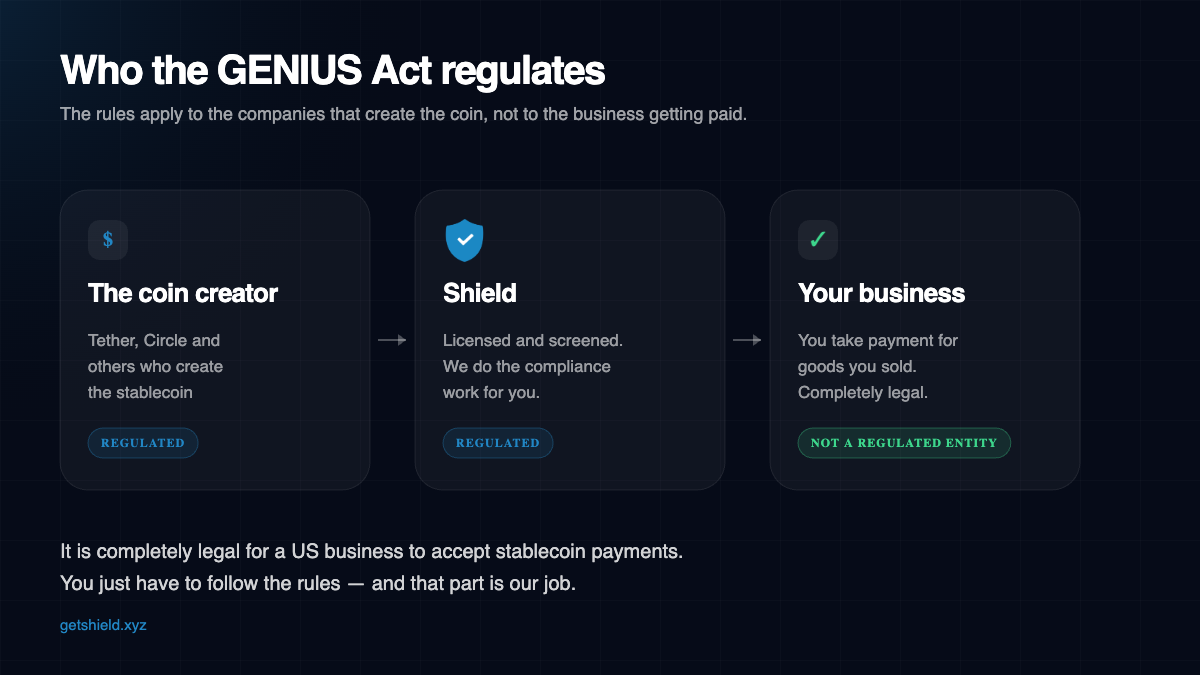
What you already have to do stays the same: know who you are dealing with, check that the money is clean, keep good records, and pay your taxes. Those rules come from anti-money-laundering law and the tax code. They applied long before the GENIUS Act and they will apply after it.
The part worth hearing is that you do not have to build any of that yourself. When your payments settle through a regulated partner, the wallet screening, the sanctions checks and the record-keeping happen in the background, on our side of the wall. You send an invoice. We do the rest. Our guide to accepting USDT payments legally walks through exactly what that looks like.
What actually changes for you
Three things change in practice.
Your bank gets a clearer test. Today a compliance officer looking at your stablecoin flows is making a judgement call. After the framework is live, there is a bright line: is this a permitted payment stablecoin from an approved issuer, or not. Businesses holding compliant tokens should find banking conversations easier, not harder.
Which coin your buyer uses starts to matter. If a stablecoin you regularly accept does not get approved, US exchanges and banks will eventually stop touching it. That becomes your problem to convert, even though the rule lands on the issuer. You do not need to monitor this. We do, and we will tell you if something your buyers use starts to look shaky. If you are curious about the mechanics, we explain TRC-20 versus ERC-20 separately.
Documentation expectations rise. Regulated issuers and their banking partners will push standardised reporting downstream. Businesses already keeping invoice-level records tied to on-chain transactions will barely notice. Businesses running informal wallet-to-wallet settlement will feel it.
What you actually need to do
Honestly? Very little.
You do not need to learn which stablecoins get approved. You do not need to know which network a payment travelled on, or read a reserve report, or work out whether your buyer used the right kind of wallet. None of that is your job, and none of it is a good use of a trading day.
That is what we are for. Shield settles in USDT and other credible, treasury-backed stablecoins, screens every wallet that pays you before the money lands, and turns the whole thing into a plain dollar record your bank will accept without a phone call.
The only part we need from you is the part only you have: the invoice and the shipping documents. Send those and the compliance file builds itself.
If you settle somewhere else, ask them one question, will you still support the coins my buyers send me after the rules take effect? A clear answer is a good sign. A vague one is also an answer.
What the GENIUS Act USDT rules mean in practice
For legitimate trade businesses, the GENIUS Act USDT rules are good news. They move stablecoins from a grey zone into a supervised one, which is precisely what a bank needs before it will treat your USDT revenue as ordinary business income. The work between now and 2027 is not new licensing. It is knowing what you hold, choosing a settlement partner that will still be compliant on the other side of the deadline, and keeping records that survive scrutiny.
Keep reading
- How US wholesalers accept USDT payments legally
- The real risks of crypto payments for businesses
- USDT payments for wholesalers: getting paid in USD
Sources
- OCC, GENIUS Act Regulations: Notice of Proposed Rulemaking
- OCC, GENIUS Act AML and Sanctions Compliance NPRM
- Federal Register, FDIC GENIUS Act requirements
- Chapman and Cutler, GENIUS Act rulemaking tracker
- Sullivan and Cromwell, OCC proposes regulations to implement the GENIUS Act
Shield is a FinCEN-registered MSB built by founders who ran trade businesses themselves. Meet the team behind Shield.