If you want to keep bank account accepting USDT, understand this: banks do not close accounts because you touched stablecoin. They close accounts because they cannot explain your activity to their own regulator. The difference matters, because the first is out of your control and the second is entirely within it. Businesses that document counterparties, screen wallets, and match every payment to a shipment keep their banking. Businesses that cannot answer where the money came from lose it.
In this article
Why banks actually de-risk accounts
A compliance officer reviewing your account is answering one question: if an examiner asks about this relationship, can I defend it. Unexplained inbound volume, counterparties in high risk jurisdictions, and activity that does not match your stated business are what make that question hard to answer.
Stablecoin flows raise the difficulty because the counterparty is a wallet address rather than a named bank account. That is solvable with screening and documentation, but only if you do it before the money arrives rather than after the bank asks.
The four controls to keep bank account accepting USDT
Four things have to be true for a bank to stay relaxed about your account. Here they are in plain English, and who actually does each one.
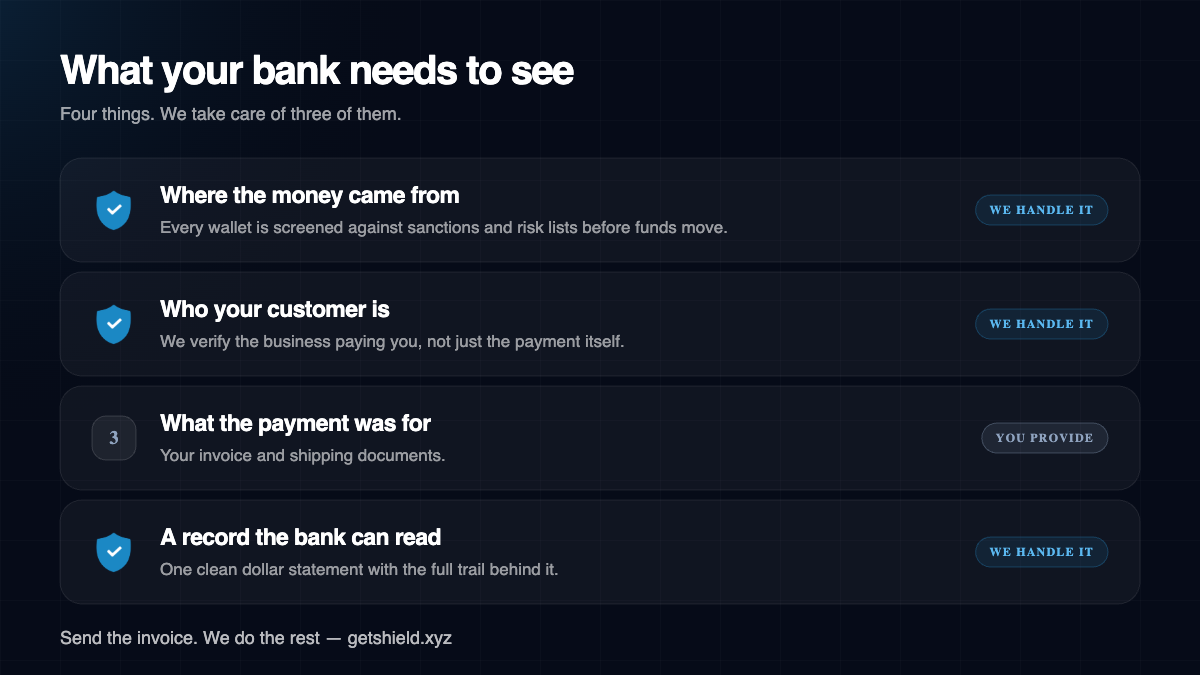
1. The money has to be clean. Every wallet that pays you is checked against sanctions lists and known bad actors before the funds settle, not after. Checking afterwards only tells you about a problem you already own. We handle this.
2. Your customer has to be a real business. A clean wallet belonging to a company nobody can identify is only half an answer. The business behind the payment gets verified too. We handle this.
3. The payment has to match a real sale. Invoice number, purchase order, shipping document and transaction reference, all pointing at each other. When a bank asks about a two hundred thousand dollar deposit, you want to send one page, not open an investigation. You send the invoice and shipping documents. We assemble the rest.
4. The money has to arrive from a regulated source. Funds landing in your account from a licensed provider look completely different to a bank than funds landing from an address nobody can name. This is what we are.
Three of those four are not your job. That is rather the point. You should be quoting containers, not reading blockchain forensics reports. If you want the deeper version, our guide to accepting USDT payments legally covers it.
What your bank will ask for, and when
Requests usually arrive after a volume jump, a new counterparty country, or a routine periodic review. The common list: transaction ledgers substantiating your monthly volume, evidence you are a genuine wholesaler such as a warehouse lease or bills of lading, signed purchase or sales contracts, and proof of payment showing the money moved as described.
Assemble that pack before you are asked. Businesses that respond within 48 hours with complete documentation almost always keep the account. Businesses that take three weeks and send partial records are the ones that get exited, even when nothing was wrong.
The behaviours that get accounts closed
Round-number transfers with no invoice behind them. Payments from wallets that belong to someone other than your customer of record. Sudden volume that does not match your stated business size. Structuring transactions just under reporting thresholds, which is itself a federal offence. And describing your business vaguely enough that a reviewer cannot tell what you sell.
Third-party payments deserve particular care. When a buyer asks to pay through an unrelated company or wallet, that is the moment to slow down and document the relationship, or decline. It is also where the real risks of crypto payments concentrate.
What to do if you are already flagged
Respond quickly and completely, and never send a partial answer hoping it satisfies the question. Provide the full chain for the flagged transactions: who paid, from which wallet, against which invoice, for which shipment, with screening results attached.
Do not move the money to another institution mid-review. That reads as evasion and follows you, because exited relationships are reportable. Fix the documentation gap, then decide whether that bank is the right long-term partner for a business with cross-border stablecoin flows.
What to do to keep bank account accepting USDT
To keep bank account accepting USDT is an operational discipline, not a legal grey area.
The businesses that keep bank account accepting USDT for years treat these controls as routine — not as a response to a warning letter.
Keep reading
- How US wholesalers accept USDT payments legally
- The real risks of crypto payments for businesses
- GENIUS Act: what it means if you accept USDT
Sources
- FinCEN, Money Services Business information center
- Chainalysis, blockchain analysis and wallet screening
- FATF, guidance on virtual assets
Shield is a FinCEN-registered MSB in Miami. See who is behind Shield and how the company is governed.